BASIC THEOREMS DIFFERENTIAL CALCULUS 1. THEOREM ENDS. If f is a continuous function defined on the closed interval, there is (at least) a point at which f takes the greatest value, and there is (at least) a point where f takes the lowest value. This theorem states that every continuous function defined on a closed interval, you must have a point at which the curve takes its maximum value and a point at which the curve takes its value mínimo.Ver Figure 1.
2. Rolle's theorem. If a function f is continuous on derivatives, and f (a) = f (b) = 0, then there exists at least one number c, such that f '(c) = 0, ie, a point c where the tangent line is parallel to the x-axis. This theorem was enunciated and demonstrated by Michel Rolle.

Example: Given the function f given by y = 2x - 2 (x) ^ 3, determines the point c between such that f '(c) = 0
check: f (1) = f (- 1) = 0
f (1) =?
f (-1) =?
Find the derivative of f, Click f '(x) = 0,
for x = c, we have that c is about 1 over root three
c The two values \u200b\u200bare in the range (-1, 1). Figure 2 shows the two tangents
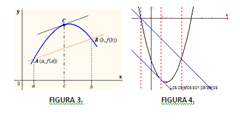
Mean Value Theorem. If a function f is continuous on derivatives, then there a number c in such that:
EXAMPLE. Consider the function. Determine the numbers c where the tangent line is parallel to the secant line through the points x = -1 x = 3
On the mean value theorem:
Then -1 is the slope of the line through the points - 1 and 3.
find f '(x), then
If there is, it must satisfy f' (c) = -1. Therefore
f '(c) = 2c-3 = -1. Then c = 1
Then in c = 1, the tangent line is parallel to the secant through the points -1 and 3. See chart.

plotting
REAL FUNCTION is a function f differentiable on, then:
CRITERIA The first derivative
SDE 1. If, for all x, then f is increasing. That is, if the slope of the tangent line is positive, then the function is increasing
2. If, for all x, then f is decreasing. That is, if the slope of the tangent line is negative, then the function is decreasing
3. If, for all x, then f is constant. That is, if the slope of the tangent line is zero, then the function does not grow or decrease
CRITICAL. Critical point is called the domain of a function f, those points where the derivative is zero or does not exist. That is, c is a critical point if f '(c) = 0. In general a critical point is that where change function of increasing to decreasing (0 or vice versa).
A curvature of a graph is called concave. The function is concave upward
CRITERIA FOR THE SECOND DERIVATIVE
f is a function whose second derivative exists in the interval, then:
1. If, for any x in, then the graph of f is concave upward. That is, if the derivative is positive, then the curve is concave upward
2. If, for any x in, then the graph of f is concave down. That is, if the derivative is negative, then the curve is concave down
3. If, for any x in, then the test does not decide. Ie can not be said about concavity. TURNING POINT
A point x = c is a turning point if, at that point. A turning point is that in which the graph of the function changes concavity.
A critical point may be a turning point, a maximum or minimum. MAXIMUM AND MINIMUM
say that a function y = f (x) has an absolute maximum at x = c, if f (c) is the largest value taken by the function, ie, if, for all x in the domain of f
say that a function y = f (x) has an absolute minimum at x = c, if f (c) is the largest value taken by the function, ie, if, for all x in the domain of f
is said a function y = f (x) has a relative maximum at x = c, if there is an interval containing c and such that for all x in the open interval.
is said that a function y = f (x) has a relative maximum at x = c, if there is an interval containing c and such that for all x in the open interval.
SEARCH CRITERIA FOR MAXIMUM AND MINIMUM
If c is a critical point of the function y = f (x), ie f '(c) = 0 and if the second derivative f''(x) exists, then:
1. If f has a relative minimum in c
2. If f has a relative maximum at c
FUNCTIONS CHART graph the function f (x) = x ^ 3 - 4x ^ 2 - 3x - 4
1.
Critical Yield function and equals zero drift, ie f '(x) = 0 Factoring the trinomial
get (3x +1) (x - 3) = 0 Do this!
each factor equal to zero: 3x +1 = 0 or, x - 3 = 0, then: x = -1 / 3, or, x = 3
For x = 3, then
For x = -1 / 3, f (-1 / 3) = Calculation! Therefore
critical points are: Write
2. Intervals where the function is increasing and decreasing
If f '(x)> 0. the function is increasing
Let (3x +1) (x - 3)> 0. Solving the above inequality gives the solution:
RESOLVE the inequality!
According to the criterion of the first derivative, say in which intervals the function is increasing and decreasing in the interval. Write them down!
3. Tipping Points
inflection points are where the second derivative is zero, ie f''(x) = 0
So f''(x) = 6x - 8, equal to zero: 6x - 8 = 0
Therefore the inflection point is?
4. Intervals where the function is concave up and concave down
If f''(x)> 0. function is concave upward. (Criterion of the second derivative)
Since f''(x) = 6x - 8. Do: 6x - 8> 0
Then the solution of the inequality is? Find it! Find
concave upward and downward. Write
intervals 5. Maximum and Minimum
Replaced the abscissa value of the critical points in the second derivative, to find the maximum and minimum (second derivative criteria), then:
For x = 3, f''(3) = 6 (3) - 8 = 18-8 = 10> 0, which is the maximum and minimum
6. GRAPH. The following is the graph obtained using the criteria of the derivative.